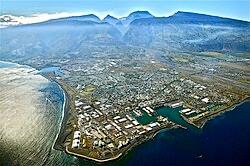
Town on Réunion Island
Le Port
A very densely populated port town in the north-west, born directly from the construction of the Pointe des Galets harbour and the railway at the end of the 19th century.
Where the name comes from
The town grew out of the construction of the Pointe des Galets harbour, begun in 1879 under the direction of engineer Alexandre Lavalley (who had worked on the Suez Canal) and opened in 1886 after seven years of work. The municipality was created in 1895 with 2,000 inhabitants. Having welcomed workers from all over the island and the Mascarenes, it remains the cradle of trade unionism in Réunion.
History
Le Port is Réunion's newest and most densely populated municipality. Founded in 1965 when part of La Possession's territory was split off, it was built from scratch around the island's commercial port, the main point of entry for imported goods. With 34,000 inhabitants on just 17 km², it is one of the most densely populated municipalities in France.
The development of the commercial port gathered pace in the 1950s and 1960s with the construction of deep-water docks suited to modern container ships. Thousands of workers moved to Le Port for jobs in port operations, cold storage and the food-processing industries that set up there. A distinctive working-class culture developed, different from the rest of the island.
Today, Le Port is the vital economic link between Réunion and the rest of the world: its harbour handles millions of tonnes of goods every year, is the town's largest employer and shapes consumer prices across the whole island. The town is also known for its annual carnival, one of the liveliest on the island, and a thriving Creole music scene.
Landscapes
Le Port is an entirely urbanised and industrialised municipality, occupying the flat land between the sea and the first hills. The commercial port dominates the coastline with its cranes, warehouses and storage yards. Virtually no natural space remains in this municipality, given over entirely to human activity.
Local culture
Le Port has developed a strong working-class, popular identity, inherited from decades of port work. The town is known for its trade-union activism, its vibrant community life and its carnival and festival traditions. The cultural diversity of the workers who came from every municipality on the island has created a distinctive cultural mix.
Why it matters
Le Port is the only municipality in Réunion born from an industrial facility: the Grand Port Maritime. A working-class town of dockers, trade unionism and railways — that is its identity.
Photo: App photo library · Internal use
Sources (2)
- https://www.insee.fr/fr/statistiques/1405599?geo=COM-97407
- https://www.ville-port.re/histoire/