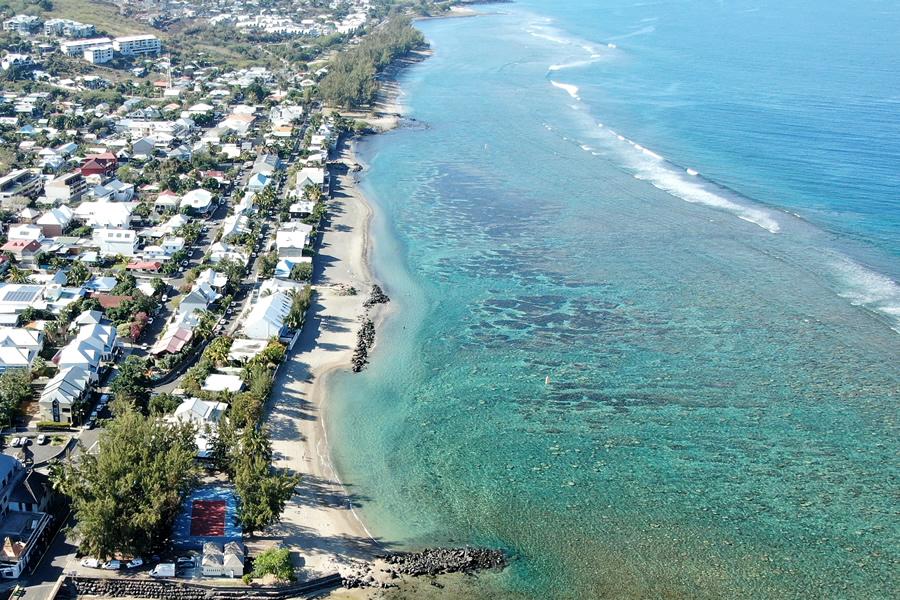
Town on Réunion Island
Saint-Leu
A municipality in the west stretching from the lagoon to the Hauts (uplands), shaped by the history of coffee, slavery and the plantations, and later by seaside and tourist activities.
Where the name comes from
Long known as “Boucan Laleu” or “Repos Laleu” after its first inhabitant, the locality took the name Saint-Leu in 1776 when the parish was created, and became a municipality in 1790. It prospered on coffee before the rise of sugar cane, and in 1811 was the scene of the only large-scale slave revolt the island ever experienced.
History
Saint-Leu is one of the most picturesque municipalities on the leeward coast, known for its preserved colonial seafront, its 19th-century Creole houses and its turquoise lagoon protected by a coral reef. Founded in the 17th century, the municipality grew up around fishing, sugar cane and, in the 19th century, a thriving whaling industry that earned it a reputation along every coast of the Indian Ocean.
The Saint-Leu rebellion of 1811 is one of the most dramatic episodes in the history of slavery in Réunion. Slaves rose up in the districts of the municipality, supporting an insurrection that was bloodily crushed: several leaders were publicly executed, leaving a lasting mark on the region's collective memory and feeding the tradition of resistance that would culminate in the abolition of 1848.
Renowned for surf spots among the best in the world, Saint-Leu hosted World Surf League competitions until the upsurge in shark attacks from 2011. The municipality is also home to the Conservatoire Botanique National de Mascarin, devoted to the endemic flora of the Mascarenes, and one of the first marine nature reserves created in overseas France.
Landscapes
Saint-Leu stretches from the coral reef of the west coast up to the wooded slopes of the Piton Maïdo and Cilaos. The coastline offers a calm, shallow lagoon protected by the reef, ideal for swimming and diving. Inland, the land rises quickly towards upland forests and terraced pastures.
Local culture
Saint-Leu has a Creole culture marked by the memory of the 1811 rebellion and by the working-class identity of its coastal districts. Surfing and water sports have forged its identity as a modern seaside town, carried by generations of Réunionese surfers. Small-scale fishermen keep up a maritime tradition inherited from colonial times.
Why it matters
The western lagoon, the Souffleur (blowhole) and Pointe au Sel: Saint-Leu carries a heavy history — that of the 1811 slave uprising — and a strong seaside identity.
Photo: App photo library · Internal use
Sources (2)
- https://www.insee.fr/fr/statistiques/1405599?geo=COM-97413
- https://www.saintleu.re/la-ville