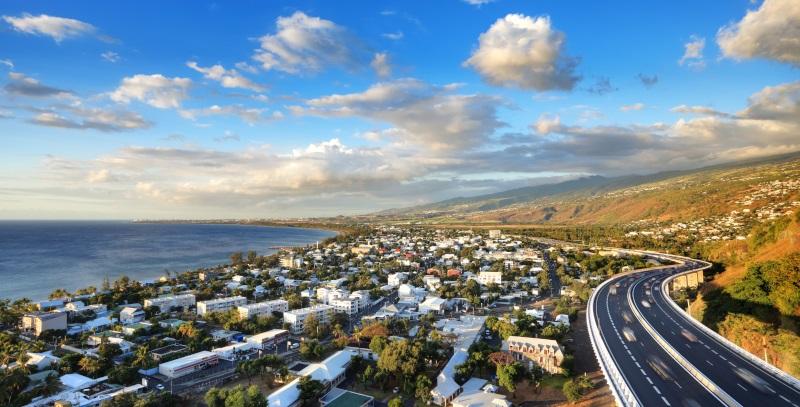
Town on Réunion Island
Saint-Paul
A large municipality in the west, from the coast to the summits, which played a founding role in the colonial settlement of Bourbon (Réunion's former name) and today brings together many seaside, urban and rural hubs as well as part of Mafate.
Where the name comes from
The island's first permanent settlement, the municipality owes its name to sailors who called here on the feast day of Saint Paul. Today it is the second most populous town in Réunion, between the coast and the Cirque de Mafate.
History
Saint-Paul was the island's first permanent settlement. On 7 July 1665, the frigate L'Écueil landed the first settlers sent by the French East India Company. Its naturally sheltered bay made it the island's first port, and Saint-Paul remained the capital of Bourbon until Saint-Denis took over that role in the 18th century.
The bay was the scene of dramatic episodes: in 1744 a British squadron bombarded it in reprisal for the capture of ships, and in 1809 the British occupied the island until 1815. Saint-Paul's seaside cemetery (Cimetière marin) holds the graves of the pirate Olivier Levasseur, known as La Buse, hanged in 1730, and of the Parnassian poet Leconte de Lisle, a native of the island.
The Cirque de Mafate, whose territory belongs to Saint-Paul, is the only cirque (natural amphitheatre) still inaccessible by road. Its 700 or so inhabitants live in îlets (hamlets) such as Roche-Plate, La Nouvelle and Aurère, supplied by helicopter. Le Maïdo, a viewpoint at 2,205 m, offers a breathtaking panorama over the cirque and, on clear days, over the island's three volcanoes.
The island's second-largest municipality, with 108,000 inhabitants, Saint-Paul combines a coastline of popular beaches (Boucan-Canot, Saint-Gilles-les-Bains) with a rich historical heritage and an exceptional mountain hinterland. The Route des Tamarins (2009) has profoundly changed travel patterns between the west coast and the capital.
Landscapes
The largest municipality on the island (284 km²), Saint-Paul offers exceptional diversity: a sandy coast and coral reef at Saint-Gilles, a historic bay at the heart of the town, farming plains, the forested slopes of Le Maïdo and the Cirque de Mafate — a basalt amphitheatre carved by erosion, rising to more than 2,000 m.
Local culture
Saint-Paul carries the memory of the island's first settlement and its founding figures: La Buse, Leconte de Lisle, the first governors of the East India Company. The seaside resort of Saint-Gilles symbolises a Creole art of living that blends beach, rougail saucisse (sausages in a spicy tomato sauce) and maloya, drawing thousands of locals every weekend.
Why it matters
Cradle of the island's colonial settlement, former capital, the western lagoon and beaches, gateway to the Cirque de Mafate and Le Maïdo: Saint-Paul sums up the full diversity of Réunion on its own — history, sea, mountains and memory.
Photo: App photo library · Internal use
Sources (2)
- https://www.insee.fr/fr/statistiques/1405599?geo=COM-97415
- https://www.mairie-saintpaul.re/histoire-de-saint-paul/