Town on Réunion Island
Sainte-Rose
A very large, sparsely populated municipality on the south-east coast, deeply bound up with the Piton de la Fournaise, its lava flows and the wild coastline.
Where the name comes from
The municipality is home to the Pointe des Cascades, the easternmost point of France and the European Union. Since 2004 it has also hosted the island's first wind farm.
History
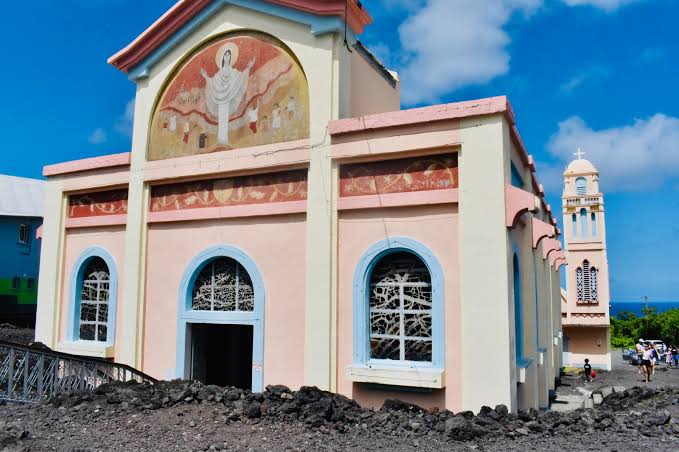
Sainte-Rose is the municipality of recent lava and humid forests. Located on the east coast below the Piton de la Fournaise, it is regularly affected by lava flows. The most memorable was in 1977, when lava engulfed a hamlet and stopped miraculously in front of the Notre-Dame-des-Laves church at Piton Sainte-Rose, sparing it after swallowing everything around it. The local people saw this as a miracle, and it strengthened the community's devotion to the Virgin Mary.
The municipality is home to the Anse des Cascades, an exceptional natural site where several waterfalls tumble straight onto a black pebble beach, framed by filaos (casuarinas) and coconut palms. It is one of the most photographed sites in Réunion. Sainte-Rose's fishing harbour, with its small colourful boats, keeps a Réunionese maritime tradition alive.
The humid tropical forests covering the slopes of the Piton de la Fournaise within Sainte-Rose are protected as a national nature reserve and lie within the core area of Réunion National Park. With only 6,500 inhabitants over 133 km², the municipality is one of the least densely populated on the island, offering unspoilt natural areas of exceptional richness.
Landscapes
Sainte-Rose is defined by the contrast between lava and forest: flows from the Piton de la Fournaise create a spectacular black-rock coastline, while the municipality's uplands are covered by the densest humid tropical forests in Réunion. The Anse des Cascades is the jewel of its landscapes.
Local culture
Sainte-Rose is a municipality of fishermen and foresters, with a calm, unhurried pace of life. The Notre-Dame-des-Laves church is a regular place of pilgrimage, a symbol of Creole faith and of the special relationship the inhabitants have with the volcano. Small-scale fishing and seaside cooking traditions are at the heart of local identity.
Why it matters
Route des Laves, Anse des Cascades and Notre-Dame-des-Laves: where volcanism meets the Indian Ocean, in a municipality that lives to the rhythm of the eruptions.
Photo: App photo library · Internal use
Sources (1)
- https://www.insee.fr/fr/statistiques/1405599?geo=DEP-974+COM-97419