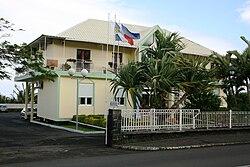
Town on Réunion Island
Saint-Philippe
A municipality in the wild south (Sud sauvage), known for its basalt cliffs, humid tropical forests and its closeness to recent volcanic lava flows.
Where the name comes from
Saint-Philippe is part of the island's historic vanilla-growing area, alongside Bras-Panon and several municipalities on the east coast — Bourbon vanilla has been grown on its volcanic slopes since the 19th century.
History
Saint-Philippe, on the island's south-eastern tip, is one of Réunion's least populated and wildest municipalities. Its territory stretches across the slopes of the Piton de la Fournaise down to the Grand Brûlé, where the volcano's lava flows sometimes reach the sea and create new land.
In its uplands, the Mare-Longue forest is one of the island's last primary lowland tropical rainforests: Réunion's first nature reserve, created in 1958, it is now part of the core of the National Park. The Route des Laves crosses the municipality alongside the lava flows, and Cap Méchant raises its black basalt cliffs against the swell.
The economy relies on farming, forest products and small-scale fishing. When a lava flow cuts the main road, the municipality can be temporarily cut off from part of the island.
Landscapes
Saint-Philippe is a land of lava: flows from the Piton de la Fournaise cover much of the municipality and form a landscape of black rock by the ocean. Higher up, the exceptionally rich Mare-Longue rainforest contrasts with the recent flows of the Grand Brûlé. At Cap Méchant, basalt cliffs and vacoas (screw pines) make up one of the wildest coastlines on the island.
Local culture
Saint-Philippe is the municipality of the living volcano: its inhabitants have made eruptions part of daily life, between vigilance and fascination with the Piton de la Fournaise. The vacoa (screw pine), whose leaves are woven into baskets and hats, is its emblem. Strong community solidarity has grown up around the volcanic hazards.
Why it matters
Cap Méchant, the Mare Longue forest and the Jardin des Parfums et des Épices: one of the wildest and least populated areas on the island.
Sources (1)
- https://www.insee.fr/fr/statistiques/1405599?geo=DEP-974+COM-97417