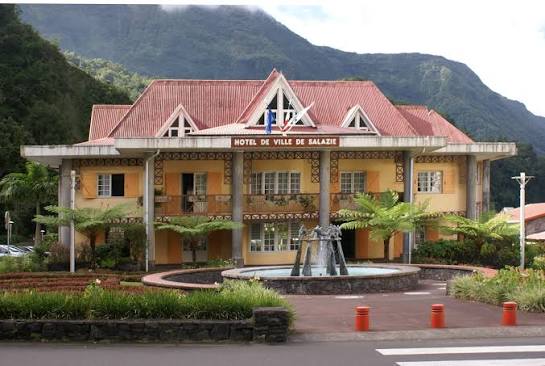
Town on Réunion Island
Salazie
A municipality lying entirely within the Cirque de Salazie, an extremely rainy mountain territory shaped by erosion, ramparts (cliff walls), waterfalls and îlets (hamlets).
Where the name comes from
The name is thought to come from the Malagasy “Soalazy”, said to mean a three-legged cooking pot — the cirque was long known as “bon campement” (good camp). The name Salazie was officially recognised in 1835. At Hell-Bourg, one of the most beautiful villages in France, hot springs were discovered by hunters in the 1830s. The cirque's cool climate also makes it the land of the chouchou (chayote), a small pear-shaped squash grown on the surrounding slopes.
History
Salazie is one of the three municipalities located in Réunion's cirques (natural amphitheatres). Its territory, which covers the Cirque de Salazie — the most accessible of the three — was gradually settled from the 18th century by families looking for cool land and upland pastures. The road into the cirque was only opened at the beginning of the 20th century.
The Cirque de Salazie is famous for its spectacular waterfalls, including the Voile de la Mariée (Bridal Veil), one of the most photographed on the island. The village of Hell-Bourg, with its Creole houses and flower-filled varangues (verandas), has been listed among the “Plus Beaux Villages de France” (Most Beautiful Villages of France) since 1999 and is one of the most complete examples of traditional Creole architecture. The cirque's landforms, with imposing ramparts several hundred metres high, bear witness to the collapse of an ancient volcanic summit.
Salazie is crossed by the GR R2 trail, the cross-island route linking Saint-Denis to the volcano. It is one of the rainiest municipalities in Réunion — the cirque receives more than 6,000 mm of rain a year — feeding permanent waterfalls and lush vegetation that give the cirque a mysterious, unspoilt atmosphere.
Landscapes
The Cirque de Salazie is a 200 km² natural amphitheatre, ringed by basalt ramparts that tower a kilometre or more above the cirque floor. Permanent waterfalls cascade down the walls, fed by extreme rainfall. The cirque's îlets (hamlets) — Hell-Bourg, Grand-Île, Mare-à-Vieille-Place — are linked by mule tracks and a few stretches of narrow road.
Local culture
Salazie embodies the culture of Réunion's uplands in its most authentic form: preserved Creole architecture, subsistence farming, upland livestock and traditions of hospitality. Hell-Bourg is the most visited village in the cirques, a symbol of the Creole mountain way of life. The people of Salazie are known for their attachment to their roots and to their exceptional natural surroundings.
Why it matters
Hell-Bourg, Grand Îlet and the Voile de la Mariée: Salazie is one of the rainiest and most spectacular areas on the island, a UNESCO World Heritage Site.
Photo: App photo library · Internal use
Sources (2)
- https://www.insee.fr/fr/statistiques/1405599?geo=COM-97421
- https://archeologie.culture.gouv.fr/ocean-indien/fr/thermes-de-hell-bourg