Chapter 9 · 1663 – 1848
Marronage
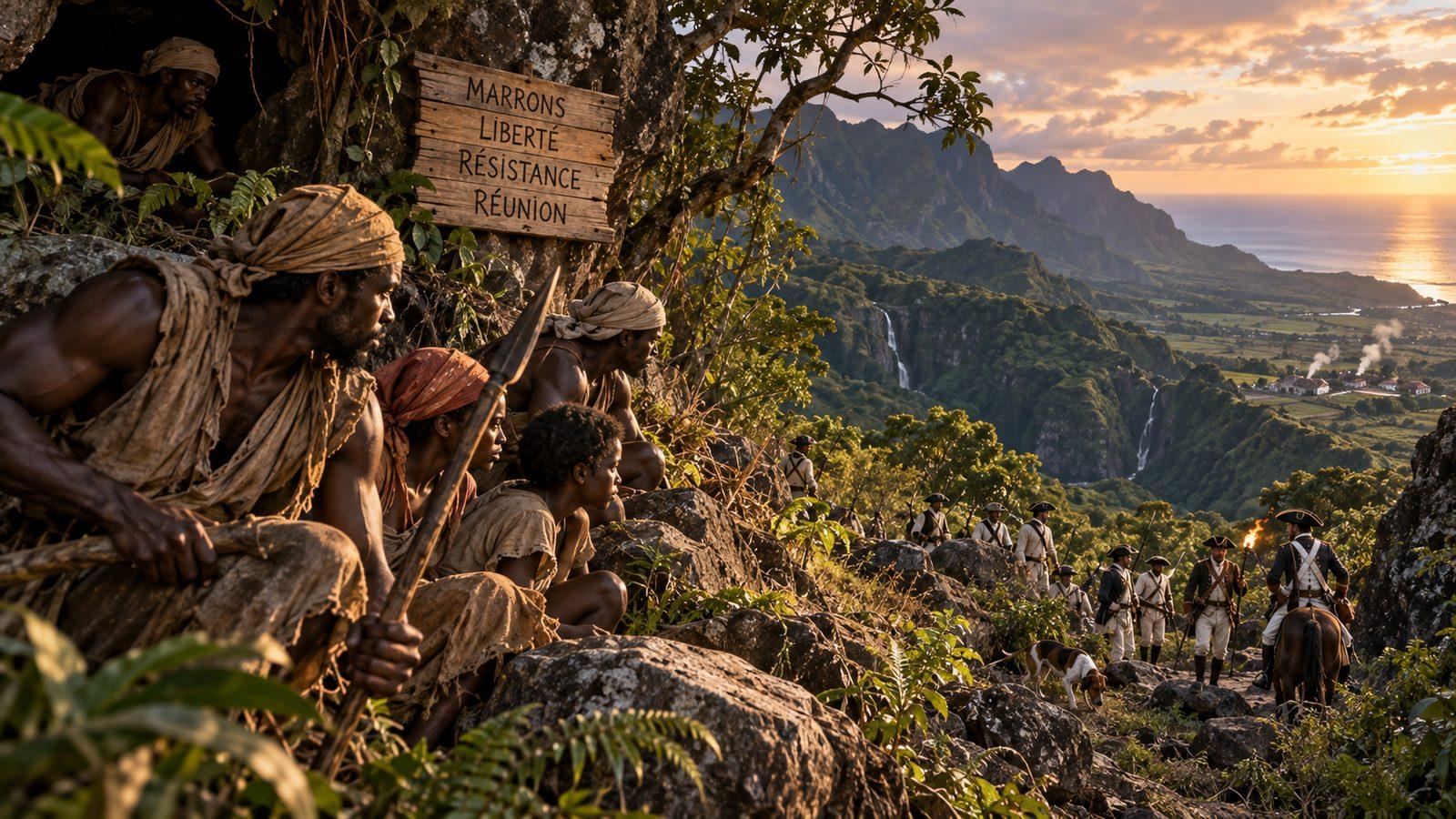
From the very beginning of slavery on Bourbon, enslaved men and women fled the plantations to take refuge in the Hauts (uplands), then almost untouched. The expeditions of militiamen tasked with tracking them down, the “chasseurs de noirs”, are well documented in the archives; the stories about the maroons themselves, however, come mainly from oral tradition, handed down and sometimes romanticised over the generations.
Mafate, a name and a maroon chief
A 1751 report mentions a maroon chief named Maffack, linked to the name of the cirque: the hunter François Mussard killed his companion Raharianne at the Rivière des Galets. The romantic portrait of this healer-chief, however, comes from an 1848 serialised novel.
Anchaing and Héva
No archival document mentions this couple. Their story, handed down through oral tradition and by 19th-century writers, has become a founding myth of Réunionese freedom.
Laverdure, Sarlave and the “kings” of the Hauts
Detachment reports from 1752 name Laverdure, described as “king of all the maroons”, and his companion Sarlave. The name of the chief Mauzac is said to come from the Malagasy mpanjaka, “king”. Written by the hunters, these sources reveal organised communities.
Place names of resistance
Cimendef, Anchaing, Dimitile: the map of the Hauts preserves the names of figures of marronage, some attested in the archives, others known through tradition. The name Cimendef already appears on a map from 1812.
The story
Marronage refers to escaping from slavery and settling, sometimes for years, in hard-to-reach areas. On Bourbon, it began in the first decades of colonisation and grew in the 18th century, with the mass arrival of enslaved people for coffee growing. The Hauts (the cirques of Mafate, Cilaos and Salazie, the slopes of the volcano, the Dimitile massif) served as refuges.
To study it, historians rely mainly on the reports of the detachments sent to track down fugitives, written from the settlers' point of view, and more recently on archaeology. Many place names in the Hauts are linked to Malagasy, but the precise meaning of each is still debated. Distinguishing what the archives say, what archaeology adds and what oral memory passes on is essential to understanding this history.
Memory today
The memory of marronage is very much alive in Réunionese culture. Place names and figures such as Anchaing bear witness to this legacy. Archaeologists and historians are continuing to document the sites occupied in the Hauts.
Photo: Illustration created for the app · Illustration, not an authentic period photograph
Sources (5)
- Prosper Ève, « Le marronnage à Bourbon/La Réunion », Portail Esclavage Réunion — https://www.portail-esclavage-reunion.fr/dossiers-documentaires/le-marronnage-a-bourbon-la-reunion/
- Gilles Pignon, « Le maronage à l'île Bourbon au XVIIIe siècle », Portail Esclavage Réunion — https://www.portail-esclavage-reunion.fr/documentaires/l-esclavage/resistances-a-l-esclavage/le-maronage-a-lile-bourbon-au-xviiie-siecle/
- Anne-Laure Dijoux, « L'archéologie du marronnage à La Réunion », Portail Esclavage Réunion — https://www.portail-esclavage-reunion.fr/documentaires/l-esclavage/resistances-a-l-esclavage/l-archeologie-du-marronnage-a-la-reunion/
- Marie-Ange Payet, « Women fugitives in Reunion », Portail Esclavage Réunion — https://www.portail-esclavage-reunion.fr/en/documentaires/slavery/resistance-to-slavery/women-fugitives-in-reunion/
- Prosper Ève, Les esclaves de Bourbon : la mer et la montagne, Karthala / Université de La Réunion, 2003