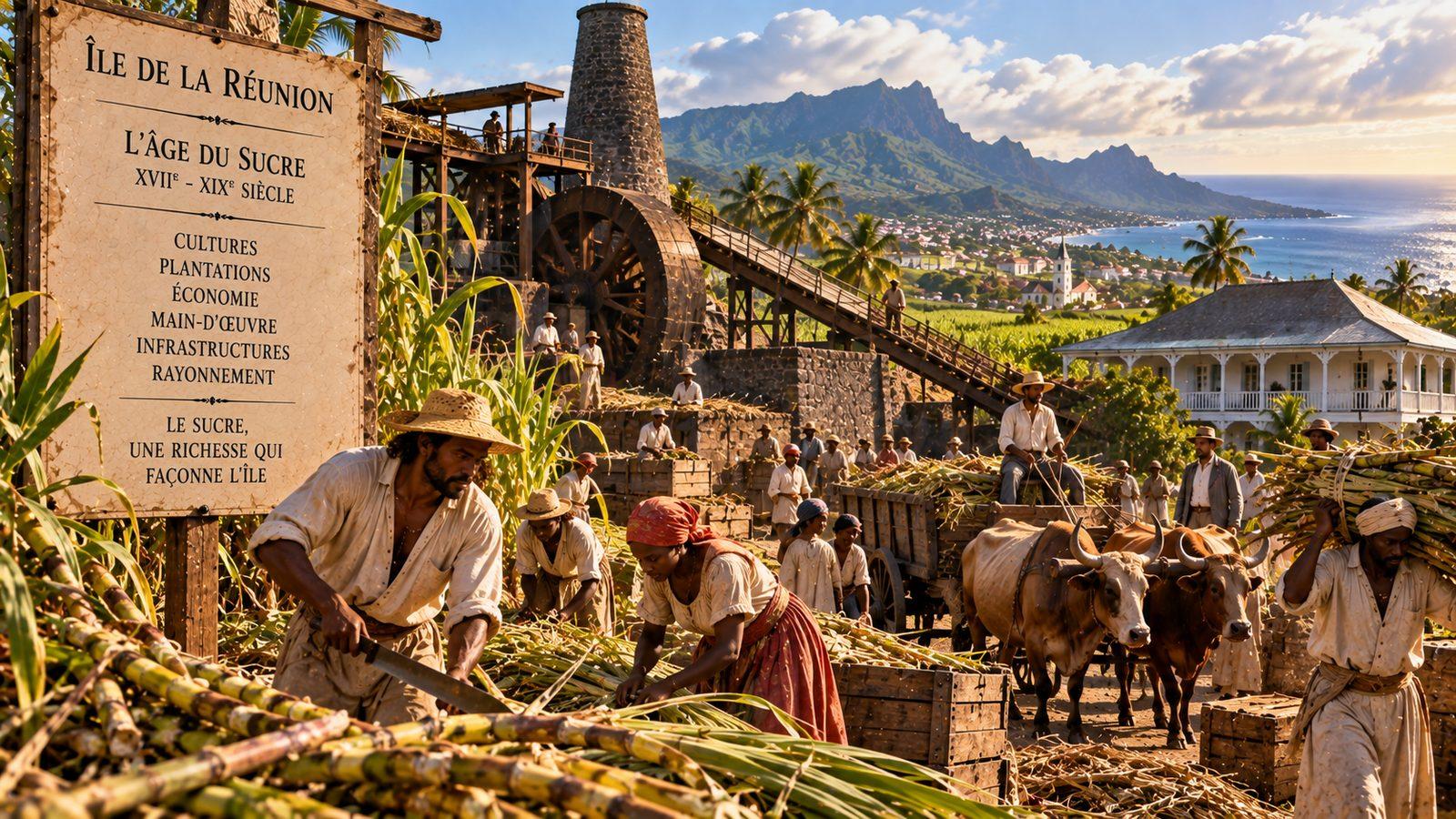
Chapter 16 · 1815 – 1900
The age of sugar
The return of the island to France in 1815, after the British occupation, cut Bourbon off from Mauritius, which had until then supplied its sugar. The planters, led by the Desbassayns family, turned massively to sugar cane, backed by increasing mechanisation.
1817, the first sugar mills
The Le Gol and Bois-Rouge factories, founded that year, were among the very first industrial sugar mills on the island.
1817, the arrival of steam engines
Following the model of the Le Chaudron factory, founded by Charles Desbassayns, steam engines gradually replaced water mills, windmills and animal-powered mills.
A transformed economy
Within a few decades, sugar cane entirely supplanted coffee as the island's dominant export crop.
The story
The sugar economy took hold in Réunion from the early 19th century. The first centralised sugar factory, on the Panon-Desbassayns estate, opened in 1827, marking the start of an industrialisation that transformed the colonial estates and concentrated production. In 1889, the Stella Matutina factory was set up at Piton Saint-Leu. The rise of sugar cane gradually replaced coffee as the dominant crop. Réunion became one of the main sugar producers in the French empire.
Photo: Illustration created for the app · Illustration, not an authentic period photograph
Sources (2)
- https://www.musee-villele.re/fr/le-musee-de-villele-et-ses-collections
- https://museesreunion.fr/musee-stella-matutina/